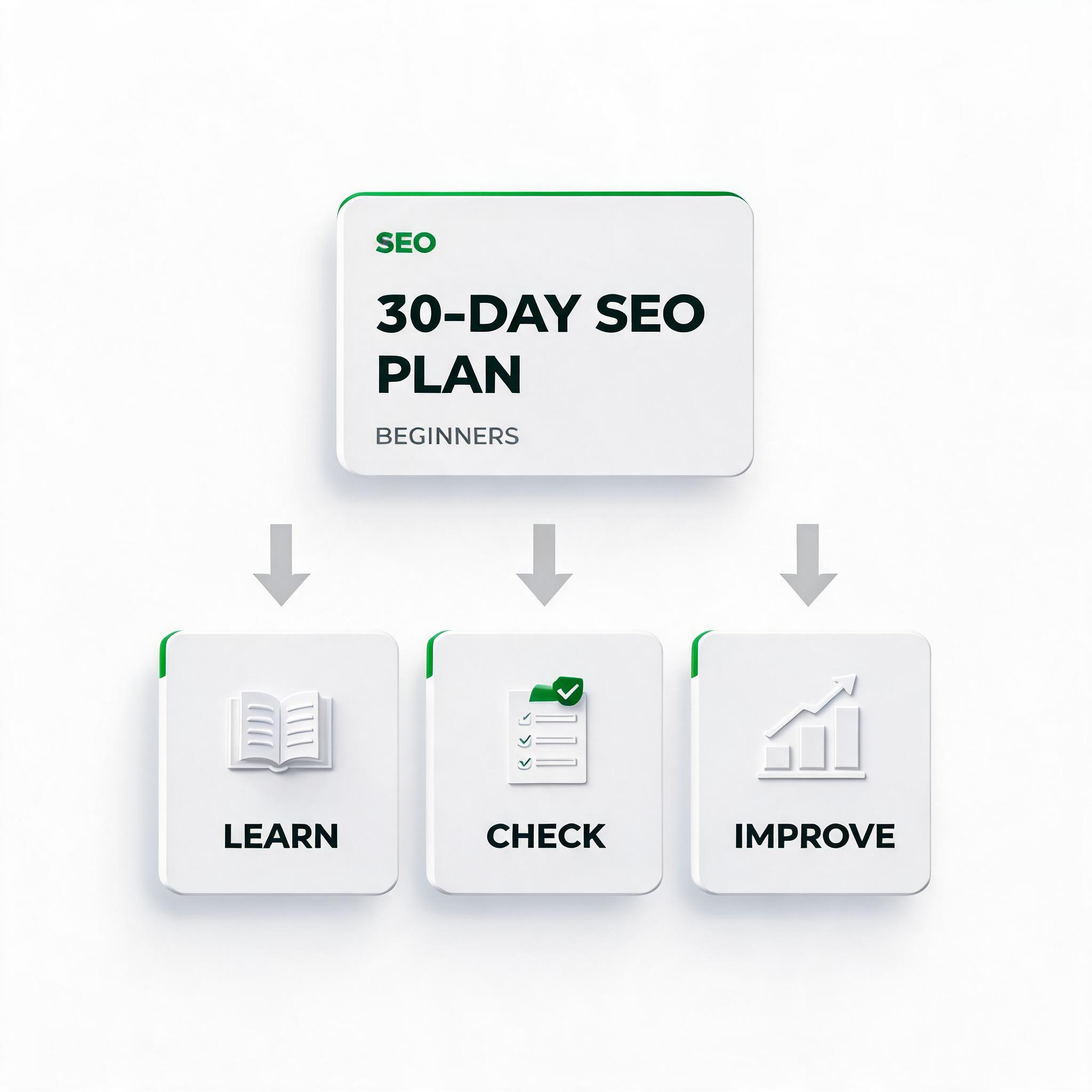
Starting an SEO journey can feel overwhelming. There are keywords to research, pages to optimize, backlinks to build, and analytics to track — all while Google's algorithm seems to change every other week. The good news? You don't need to do everything at once. A structured 30-day SEO plan gives beginners a clear, manageable roadmap to build a strong foundation without burning out. Whether you're launching a brand-new blog, improving a small business website, or simply trying to understand how search engines work, this day-by-day guide will walk you through the essential steps. By the end of 30 days, you'll have a site that's technically sound, content-rich, and positioned to climb the search rankings over time.
What Is a 30-Day SEO Plan?
A 30-day SEO plan is a structured, step-by-step framework that breaks down the core pillars of search engine optimization into daily or weekly tasks spread across one month. Instead of trying to tackle everything at once — which often leads to confusion and half-finished work — this approach divides SEO into four focused phases:
Week 1: Foundation & Audit — Understanding your current site health, setting up tools, and identifying quick wins.
Week 2: Keyword Research & Content Planning — Discovering what your audience is searching for and mapping content to those queries.
Week 4: Off-Page SEO, Monitoring & Iteration — Building authority, tracking progress, and refining your strategy.
Think of it like a fitness plan. You wouldn't try to run a marathon on day one — you'd start with stretching, build up your mileage, and gradually increase intensity. SEO works the same way. A 30-day plan helps you build sustainable habits rather than chasing quick hacks.
Subscribe to our newsletter for the latest news and updates
Without a plan, most beginners fall into one of two traps: they either do nothing because they're paralyzed by options, or they do a little of everything and see no results. A 30-day structure solves both problems.
It creates consistency. Search engines reward websites that consistently publish quality content and maintain technical health. Sporadic efforts produce sporadic results. By committing to daily action — even just 30 to 60 minutes — you build the kind of momentum Google notices.
It prioritizes what actually moves the needle. Not all SEO tasks are created equal. Fixing a broken sitemap, for example, might have a bigger impact than spending hours tweaking font sizes. A well-designed plan front-loads high-impact activities so you see progress faster.
It builds your knowledge incrementally. SEO involves technical skills, content strategy, and analytical thinking. Trying to learn all three simultaneously is like juggling while riding a bike. A phased approach lets you master one area before moving to the next.
It gives you measurable milestones. At the end of 30 days, you can look back and see exactly what you accomplished — pages optimized, keywords targeted, content published, and rankings tracked. This makes it much easier to identify what's working and what needs adjustment.
How to Do It: The 30-Day Breakdown
Week 1: Foundation & Site Audit (Days 1–7)
Day 1–2: Set Up Your SEO Toolkit. Install Google Analytics and Google Search Console on your website. These free tools are non-negotiable — they show you how people find your site, which pages perform well, and where technical issues exist. If you want a beginner-friendly alternative that consolidates multiple SEO insights into one dashboard, Osek.ai is a free tool worth exploring. It can help you quickly audit your site and identify areas for improvement without needing advanced technical knowledge.
Day 3–4: Run a Full Site Audit. Check for broken links, slow-loading pages, missing alt text on images, and crawl errors. Tools like Osek.ai can scan your site and surface these issues in a clear, prioritized report. Fix anything critical — especially 404 errors and missing meta descriptions.
Day 5–7: Analyze Your Competitors. Identify 3–5 competitors in your niche. Look at what keywords they rank for, what type of content they publish, and how their sites are structured. This isn't about copying — it's about understanding the competitive landscape so you can find gaps and opportunities.
Week 2: Keyword Research & Content Planning (Days 8–14)
Day 8–10: Build Your Keyword List. Start with broad topics related to your business, then drill down into specific long-tail keywords. For example, if you sell handmade candles, your seed keywords might be "soy candles," "scented candles," and "candle gifts." From there, you'd expand into phrases like "best soy candles for relaxation" or "how to make scented candles at home." Osek.ai offers keyword research capabilities that help you discover relevant terms along with search volume and difficulty metrics — perfect for beginners who want data-driven insights without a steep learning curve.
Day 11–12: Map Keywords to Pages. Assign a primary keyword to each existing page on your site. Avoid keyword cannibalization — don't let two pages compete for the same term. Create a simple spreadsheet tracking each page, its target keyword, search volume, and current ranking position.
Day 13–14: Create a Content Calendar. Plan 4–8 new blog posts or pages based on your keyword research. Prioritize topics with moderate search volume and lower competition — these are the "low-hanging fruit" that beginners can realistically rank for.
Day 15–17: Optimize Existing Pages. Update title tags, meta descriptions, header tags, and URL structures for your most important pages. Ensure each page has a clear H1 that includes the target keyword, uses H2s and H3s to organize content, and includes internal links to related pages.
Day 18–19: Publish New Content. Write and publish at least two new pieces of content from your calendar. Focus on depth, readability, and answering real user questions. Aim for 1,000–2,000 words per post for competitive topics — Google tends to favor comprehensive content.
Day 20–21: Optimize Images & Page Speed. Compress images, add descriptive alt text, and enable browser caching. A slow site hurts both user experience and rankings. Use Google's PageSpeed Insights to identify specific bottlenecks.
Week 4: Off-Page SEO, Monitoring & Iteration (Days 22–30)
Day 22–24: Build Initial Backlinks. Reach out to relevant blogs for guest posting opportunities, submit your site to reputable directories, and share your content on social media. Focus on quality over quantity — one link from a respected site in your niche is worth more than 50 links from irrelevant directories.
Day 25–27: Set Up Tracking & Monitoring. Configure rank tracking for your target keywords. Check Google Search Console for indexing issues, crawl stats, and emerging keyword opportunities. Osek.ai can serve as a convenient hub for ongoing monitoring, letting you track keyword performance and site health in one place without constantly switching between multiple tools.
Day 28–30: Review, Analyze & Plan Ahead. Compare your Day 1 baseline with your current metrics. What improved? What didn't? Identify your top-performing content and double down on similar topics. SEO is an ongoing process — the 30-day plan is just the beginning.
Example: Weak SEO vs. Better SEO
Weak Example: A bakery website has a homepage titled "Welcome to Our Bakery!" with a paragraph that says, "We make delicious cakes and bread. Come visit us!" There's no keyword targeting, no structured headings, no internal links, and no blog content.
Better Example: The same bakery updates its homepage title to "Custom Birthday Cakes & Fresh Artisan Bread | [City Name] Bakery." The page now features H2 sections for "Our Custom Cake Menu," "Fresh Bread Baked Daily," and "Why Customers Love Us." Each section includes natural keyword usage, internal links to individual product pages, and a blog with posts like "5 Tips for Choosing the Perfect Birthday Cake" — a post targeting the long-tail keyword "how to choose a birthday cake." Within weeks, the bakery starts ranking for local search queries it never appeared in before.
The difference isn't magic — it's intentional, structured optimization. That's exactly what a 30-day plan delivers.
Common Mistakes
Skipping the audit. Many beginners jump straight into keyword research without understanding their site's current state. You can't chart a course if you don't know your starting point.
Targeting only high-volume keywords. New sites rarely rank for competitive terms immediately. Focus on long-tail keywords with lower difficulty scores — they convert better and are more achievable.
Ignoring technical SEO. Content is king, but a site with broken links, missing sitemaps, and slow load times will struggle no matter how good the content is.
Not tracking progress. If you're not measuring results, you're guessing. Set up tracking tools from day one and review your data weekly.
Expecting instant results. SEO is a long game. Most sites see meaningful improvements within 3–6 months. The 30-day plan builds the foundation — results follow with patience and consistency.
Creating content without search intent in mind. Writing what you *want* to say rather than what people are *searching for* is a common trap. Always start with keyword research and user intent.
Quick Checklist
Install Google Analytics and Google Search Console
Run a full technical site audit and fix critical errors
Identify 3–5 competitors and analyze their strategies
Build a keyword list with 20–50 targeted terms
Map primary keywords to each page (no cannibalization)
Create a content calendar with 4–8 planned posts
Optimize title tags, meta descriptions, and headers on key pages
Publish at least 2 new, keyword-targeted pieces of content
Add internal links between related pages
Compress images and add alt text
Check page speed and address major issues
Begin outreach for backlinks (guest posts, directories)
Set up rank tracking for your target keywords
Review all metrics at Day 30 and plan the next month
FAQ
How long does it take to see results from a 30-day SEO plan? While you may see early improvements — like faster indexing, better crawl health, and initial keyword movement — significant ranking and traffic gains typically take 3 to 6 months. The 30-day plan is designed to build the foundation that makes those results possible. Think of it as planting seeds: the work you do in month one pays off in months three through twelve.
Can I do SEO without paying for expensive tools? Absolutely. Google Analytics, Google Search Console, and tools like Osek.ai provide powerful SEO insights at no cost. As a beginner, you don't need premium tools to make meaningful progress. Start with free resources, and only invest in paid tools when your needs outgrow what's available for free.
How much time should I spend on SEO each day during the 30-day plan? Plan for 30 to 60 minutes per day on focused SEO tasks. Some days — like running an audit or publishing content — might take longer. Others, like checking Search Console or responding to a backlink opportunity, might take just 15 minutes. Consistency matters more than duration.
Should I focus on content or technical SEO first? Start with technical SEO during Week 1. If your site has crawl errors, broken pages, or poor load times, even the best content won't rank well. Once your technical foundation is solid, shift your focus to content creation and optimization — which takes center stage in Weeks 2 and 3.
Is this 30-day plan suitable for e-commerce sites or just blogs? The core principles apply to any type of website — blogs, e-commerce stores, service businesses, portfolios, and more. E-commerce sites may need to pay extra attention to product page optimization, site architecture, and schema markup, but the phased approach of audit → research → optimize → monitor works universally.