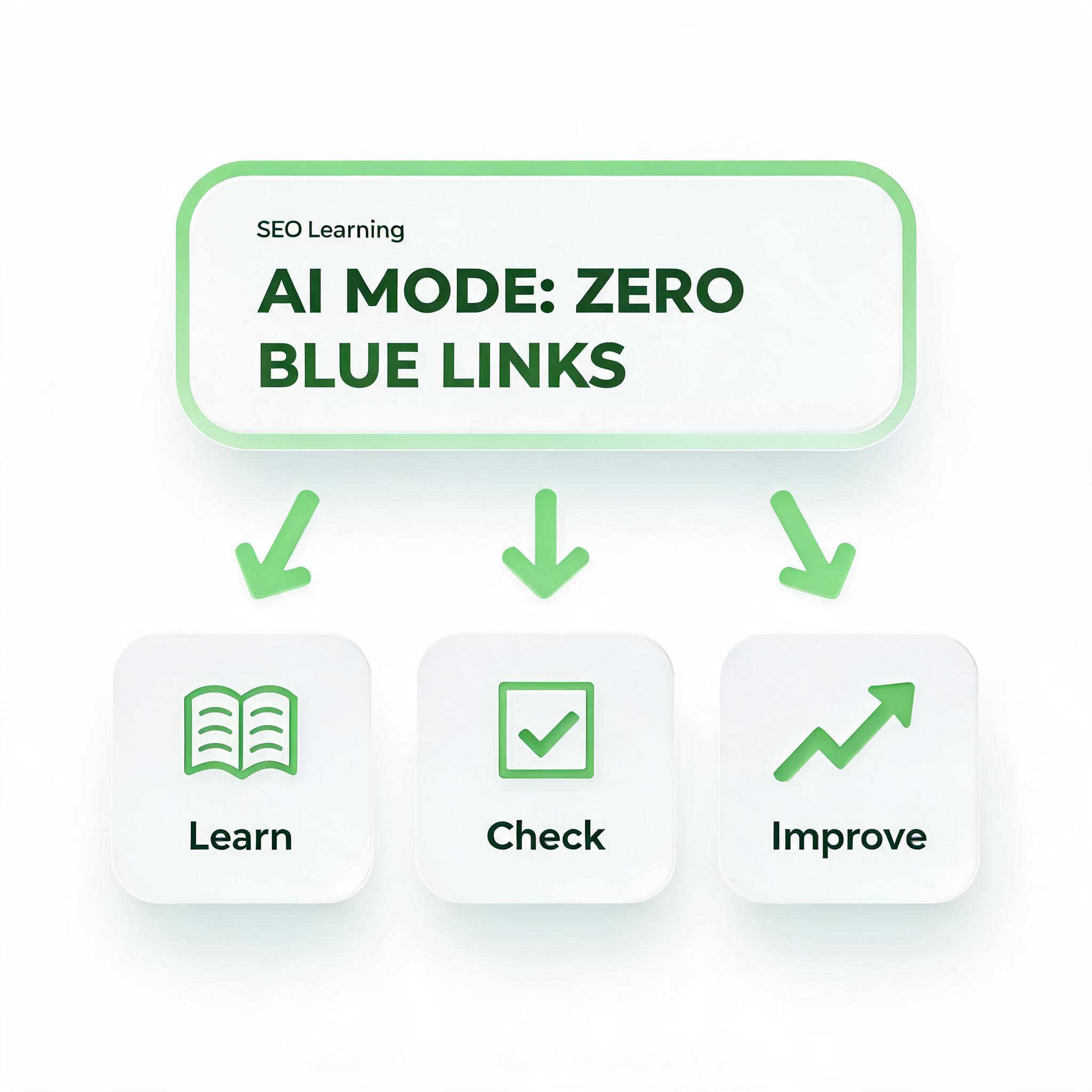
Google has always been about ten blue links on a search results page. For over two decades, that simple format was the backbone of the internet — and the foundation of every SEO strategy ever built. But something dramatic is happening right now. Google's AI Mode is rolling out, and it's creating search result pages where traditional organic links barely exist — or disappear entirely. If you're a website owner, content creator, or marketer, this shift isn't just interesting news. It's an existential moment for how you think about getting found online. Let's break down exactly what's changing, why it matters, and what you can do to stay visible.
What Is AI Mode in Google?
AI Mode is Google's latest evolution of search, powered by Gemini, its most advanced AI model. Unlike a standard Google search that returns a ranked list of website links, AI Mode generates a full conversational response directly on the results page. The AI reads, synthesizes, and summarizes information from across the web — then presents the answer in natural language.
Think of it like this: instead of Google handing you a library card and saying "go find the answer yourself," it now walks you to the shelf, pulls out the relevant books, and writes a summary for you on the spot.
Here's what makes AI Mode different from earlier features like AI Overviews:
Full-page AI answers. AI Mode doesn't just add a summary box at the top of results — it essentially *replaces* the traditional results page with an AI-generated conversation.
Zero or near-zero blue links. In many queries, the classic organic results either don't appear at all or are pushed so far down the page that almost nobody scrolls to see them.
Follow-up capability. Users can ask follow-up questions within the same interface, keeping them inside Google's ecosystem rather than clicking through to websites.
Subscribe to our newsletter for the latest news and updates
Multimodal understanding. AI Mode can process text, images, and complex multi-part queries — going far beyond simple keyword matching.
The "zero blue links" phenomenon is the most alarming part for SEO professionals. When there are no blue links to click, the traditional model of "optimize your page → rank #1 → get traffic" starts to break down.
Why It Matters for SEO
This isn't a minor algorithm update. AI Mode represents a fundamental restructuring of how search works, and it has massive implications for anyone who depends on organic traffic.
Traffic is at risk of declining. Multiple studies have already shown that when AI-generated answers appear at the top of search results, click-through rates on organic links drop significantly. AI Mode takes this further by removing those links altogether in many cases. If your business model relies on getting people to visit your website from Google, you need to pay close attention.
The definition of "ranking" is changing. In the old world, you wanted to be result #1. In the AI Mode world, you want your content to be *cited* or *referenced* inside the AI's generated answer. That's a completely different optimization challenge. Visibility no longer means a clickable link — it means being the source the AI trusts enough to draw from.
Content quality expectations are rising fast. AI Mode pulls from sources it deems authoritative, comprehensive, and trustworthy. Thin, keyword-stuffed, or surface-level content is far less likely to be referenced. Google's AI is essentially acting as the world's most sophisticated content editor — and it's very picky.
New metrics matter. Traditional SEO metrics like keyword rankings and organic impressions become less meaningful when the search results page itself is transformed. You'll need to start tracking whether your content appears in AI-generated answers, how often it's cited, and whether brand visibility is maintained even without direct clicks.
For beginners, the key takeaway is this: SEO isn't dying, but it's evolving dramatically. The skills that matter are shifting from "how to game the algorithm" toward "how to be the best, most authoritative source on a topic."
How to Do It / How to Check
So how do you adapt? Here's a practical, step-by-step approach to making your content AI Mode-friendly.
1. Audit Your Current Visibility in AI Results
Before you change anything, you need to understand where you stand right now. Manually search for your most important keywords in Google and observe whether AI Overviews or AI Mode responses appear. Note whether your site — or your competitors' sites — are cited as sources.
A free tool like Osek.ai can help you analyze your site's current SEO performance and identify content gaps. It's particularly useful for spotting which pages on your site are strong candidates for AI citation and which ones need improvement.
2. Create Definitive, Source-Worthy Content
AI Mode favors content that thoroughly answers a question. This means:
Go deep, not wide. Instead of writing ten shallow blog posts, create three comprehensive guides that cover a topic from every angle.
Use clear structure. Headings, subheadings, bullet points, and tables help AI models parse and understand your content more easily.
Include original data and insights. AI models prefer citing sources that offer something unique — proprietary research, expert opinions, case studies, or original frameworks.
3. Build Topical Authority
Google's AI tends to trust sources that demonstrate expertise across an entire topic area, not just a single page. Build topical authority by creating content clusters — groups of interlinked pages that comprehensively cover a subject.
4. Optimize for Entities, Not Just Keywords
AI Mode understands *entities* — people, places, concepts, products — rather than just matching keywords. Make sure your content clearly establishes your expertise on specific entities using structured data, consistent terminology, and authoritative backlinks.
5. Monitor and Adapt Continuously
This landscape is changing fast. Use tools like Osek.ai to regularly check your site's health, track keyword opportunities, and ensure your content stays competitive as Google's AI continues to evolve.
Example: Weak vs. Better
Let's look at a practical example to illustrate the difference.
The Query: "How to choose a standing desk for back pain"
Weak Content (Unlikely to Be Cited in AI Mode)
> *Standing desks are great for back pain. There are many standing desks you can buy online. Some are electric and some are manual. You should consider your budget when buying a standing desk. Standing desks can help you be more productive at work. Check out our top picks below!*
This content is vague, offers no specific guidance, reads like filler, and provides nothing an AI model couldn't generate on its own. It has zero original value.
Better Content (Strong Candidate for AI Citation)
> *Choosing the right standing desk for back pain depends on three factors: adjustability range, surface area, and transition speed. Based on our testing of 18 models over 6 months, here's what matters most:* > > - *Adjustability range:* *Look for desks that adjust between 25"–50" to accommodate both sitting and standing positions for users between 5'2" and 6'4".* > - *Weight capacity:* *For dual-monitor setups common in office environments, a minimum 150 lb capacity prevents wobble — a leading cause of posture compensation that worsens back pain.* > - *Transition speed:* *Desks that take more than 15 seconds to change position discourage users from alternating, which reduces the back-pain benefits by up to 40% (Journal of Occupational Health, 2023).* > > *For chronic lower back pain specifically, we recommend starting with 20-minute standing intervals and gradually increasing to 45 minutes over 4–6 weeks.*
This content is specific, data-backed, structured, and provides genuine expert guidance — exactly the kind of material AI Mode loves to reference.
Common Mistakes
As the industry scrambles to adapt to AI Mode, some predictable mistakes are emerging.
Ignoring AI Mode entirely. The biggest mistake is pretending this isn't happening. Some site owners are still optimizing purely for traditional blue links and hoping AI Mode won't affect them. It already is.
Over-optimizing for AI at the expense of humans. Remember, even in an AI Mode world, humans still read your content when they do click through. Don't sacrifice readability and user experience in pursuit of AI-friendliness.
Neglecting brand building. When zero blue links appear, brand recognition becomes your safety net. Users who know your brand are more likely to search for you directly or recognize your name in an AI citation. Invest in brand awareness alongside your SEO efforts.
Producing AI-generated content to compete with AI. There's a certain irony in using ChatGPT to write generic articles and hoping Google's AI will cite them. Google's systems are specifically designed to identify and deprioritize generic AI-generated content. Original expertise wins.
Failing to track new metrics. If you're still only measuring keyword rankings and organic traffic, you're flying blind. Start tracking AI citation rates, brand mentions, and zero-click search impressions.
Quick Checklist
Use this checklist to evaluate and improve your content's readiness for AI Mode in Google:
Audit existing content for AI Overview/AI Mode appearances on your target keywords
Create comprehensive, in-depth guides that cover topics from multiple angles
Use clear content structure with descriptive H2/H3 headings, lists, and tables
Include original data, research, or expert insights that add unique value
Build topical authority through content clusters and internal linking
Implement structured data markup (schema.org) to help AI understand your content
Optimize for entities and concepts, not just exact-match keywords
Strengthen brand visibility across multiple channels (social, PR, partnerships)
Use a free SEO tool like Osek.ai to identify content gaps and optimization opportunities
Monitor AI citation performance and adjust strategy quarterly
Ensure E-E-A-T signals (Experience, Expertise, Authoritativeness, Trustworthiness) are clear on every page
Keep human readability a priority — write for people first, algorithms second
FAQ
Will SEO become obsolete because of AI Mode?
No, but it will transform significantly. SEO will shift from "ranking for blue links" toward "being the authoritative source that AI references." The core principles of creating great content, building authority, and understanding your audience remain essential. The tactics and metrics, however, are evolving rapidly.
How can I tell if my content is being cited in AI Mode?
Currently, Google doesn't provide a dedicated "AI citation" report in Search Console. The best approach is to manually search your key topics in Google and observe whether your site appears as a cited source in AI-generated answers. Tools like Osek.ai can help you track your overall SEO performance and identify which pages have the strongest authority signals.
Should I block Google's AI from using my content?
This is a personal decision with trade-offs. Blocking AI access might protect your content from being summarized without a click, but it also removes your brand from AI-generated answers entirely. For most sites, being cited in AI Mode — even without a direct click — provides valuable brand visibility and positions you as an authority.
How fast is AI Mode being rolled out?
Google has been gradually expanding AI features across search since 2023. AI Mode is currently available to a growing number of users in the United States, with international expansion expected. The pace is accelerating, so preparing now is far better than reacting later.
What's the single most important thing I can do right now?
Focus on creating content that is so thorough, so well-structured, and so uniquely valuable that Google's AI has no better source to cite. That means original research, genuine expertise, clear writing, and strong topical authority. If you do nothing else, audit your top 10 pages using a tool like Osek.ai and ask yourself: "Would an AI choose my page as the best answer on this topic?" If the honest answer is no, you have your starting point.
AI Search Visibility
See whether your content is easy for AI answer engines to understand.